
The body lay in front of us, broken beyond recognition. His uniform was torn, his hands cut off, and his face so damaged that even a mother could not know her own son. My mother fell to the ground, crying in deep pain, holding the lifeless body that was once her child. My family’s screams filled the air, and I stood still, my heart breaking apart as I saw my brother return—not as a proud soldier, but as a martyr in pieces. The weight of that moment crushed me, and I cried so hard I could barely breathe.
My Brother’s Journey
My brother was just eighteen when he joined the army, full of energy, passion, and the dream of achieving martyrdom. He was so proud to wear the uniform and ready to sacrifice everything for his country. His very first posting was in Waziristan, a place that at that time was completely under the control of terrorists. These two things kept on overthinking in my mind: Waziristan being one of the most dangerous areas, and my brother’s strong wish to become a martyr. As a result, my mind began creating problems that did not actually exist, conjuring up painful scenes that never occurred.
When the Brain Becomes the Enemy
But the truth is, the scene I described never existed. It wasn’t real—it was only my brain creating it through negative thinking. Yet I felt it so deeply that it became my reality, and I cried for hours in my blanket while everyone else slept. This is the power of the human mind: it can build stories that don’t exist and still make us feel the pain as if they were true. These battles don’t happen outside us—they happen inside our own heads. This inner fight, this conflict between what is real and what the brain imagines, is what we call rumination.
What is Rumination?
Yes, the word “rumination” actually comes from cows and other animals that chew cud. A cow eats, swallows, and then brings the food back up to chew it again and again.
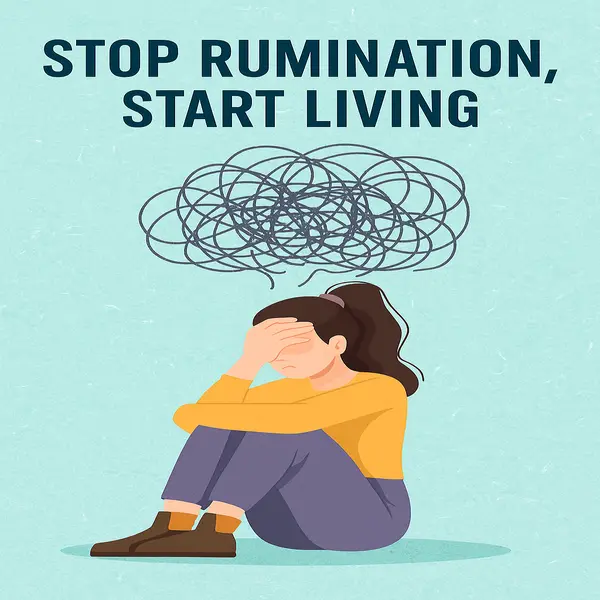
In psychology, the term is used as a metaphor. Just like the cow chews the same food over and over, our brain “chews” the same thoughts repeatedly—especially negative ones—without reaching a solution. That’s why thinking about the same painful memory or worry again and again is called rumination in psychology.
This pattern of thought relates closely to my reflections on mental health awareness, where chronic overthinking and emotional fatigue are explored in depth.
Why Does Rumination Happen?
Rumination happens because our brain is naturally designed to solve problems. Whenever something feels wrong—like a mistake, a conflict, or an uncertain future—the mind starts replaying it again and again, hoping to find answers. But instead of solving it, the brain often gets stuck in a thought loop, chewing the same worry without reaching a solution.
Another big reason is emotional pain. When we feel fear, regret, or anxiety, the mind tries to make sense of those feelings by creating stories or repeating past events. For some people, perfectionism, low self-esteem, or stress can also act as triggers. In reality, overthinking symptoms like these is the brain’s way of trying to protect us, but instead of helping, it makes the pain even stronger.
Common Examples of Rumination
- After an argument
Imagine you argue with a friend or family member. In the moment, you couldn’t reply the way you wanted. Later, when you are alone, your mind starts replaying the whole scene again and again. You think, “I should have said this… if only I answered like that.” Even though the argument is over, your brain keeps you stuck in that loop. - Before making a decision
Sometimes when we need to make an important decision—like choosing a career, changing a job, or even buying something—our brain doesn’t let us relax. It keeps showing us every possible outcome, especially the worst ones. Instead of moving forward, we remain stuck, thinking, “What if I fail? What if things go wrong?” - Remembering past mistakes
Many times, our mind pulls us back to a mistake we made long ago. Even if no one else remembers it, we keep punishing ourselves in our head. We think about how things could have been different if we acted another way, but the truth is the past cannot be changed. - Fear of the future
Rumination also happens when we keep imagining problems that haven’t even happened. For example, before exams you may picture yourself failing, or if a loved one travels, you may imagine accidents. These fears may never come true, but the pain they bring feels real. - Comparing yourself with others
In today’s world, it’s easy to compare yourself with classmates, colleagues, or people on social media. Your brain may keep asking, “Why am I not as successful as them? Why am I behind?” These thoughts repeat endlessly and only make you feel worse. - Overthinking small things
Sometimes it’s not even big events. Maybe you said something wrong in a meeting or acted awkwardly in front of people. Even if others have forgotten it, your brain replays that one small moment like a broken record, making you feel embarrassed again and again.
You Are Not Alone in This Battle
While I write these examples, I can’t stop feeling that every single one of them is about me. These are not just random situations—I have lived them, over and over again, inside my mind. Maybe you have too. Maybe you’ve cried alone at night, replaying an argument or imagining a future that hasn’t even happened. If you’re reading this and you feel like I’m describing your own life, then know this—you are not alone. Many of us are fighting these silent battles in our heads, and the pain feels just as real as anything in the outside world and we all are in a situation that how to stop overthinking?
The Effects of Rumination
Rumination might look like “just thinking,” but the truth is it takes a heavy toll on both the mind and the body. When we keep repeating the same painful thoughts, we relive the same pain again and again, as if the wound never heals. It drains our energy, steals our peace, and leaves us stuck in the past or scared of the future instead of living in the present.
On a mental level, rumination increases stress, anxiety, and even depression. It makes you doubt yourself, lowers your confidence, and can make even small problems feel impossible to handle. Physically, it can disturb your sleep, exhaust your body, and leave you tired even when you’ve done nothing all day. Socially, it creates distance—you may avoid people, withdraw from conversations, or feel disconnected because your mind is too busy fighting its own battles. In short, rumination doesn’t just affect your thoughts—it silently touches every corner of your life.
Whenever I go through this cycle of rumination, I can feel clear changes in my physical health. It feels as if my body suddenly loses months of strength and progress, pulling me back three steps for every one I take forward. The weight of my thoughts doesn’t just stay in my mind—it weakens my body a lot, and I stay angry all the time.
Is Rumination a Disorder?
Rumination disorder itself is not a disease—it’s more like a habit of the mind. Our brain slips into this loop when it tries too hard to solve problems or make sense of our emotions. Almost everyone experiences it, so we don’t need to panic if it happens sometimes. But if rumination becomes too frequent, steals our sleep, or keeps us stuck in sadness and fear, then it’s a sign we should pay attention and take steps to manage it.
How to Stop Overthinking or Rumination?
Rumination can feel like a trap, but the good news is that it’s possible to break free. It takes practice, but small steps can make a big difference. Here are some simple ways to stop your mind from repeating the same painful loops:
- Catch your thoughts – The first step is awareness. When you notice your mind replaying the same scene, pause and remind yourself: “This is just my mind, not reality.”
- Shift your focus – Do something that pulls your attention into the present moment: take a walk, talk to a friend, or even do a small task around the house.
- Write it down – Journaling can help release thoughts from your head onto paper. Once you write them, your mind doesn’t feel the need to repeat them as much.
- Practice mindfulness – Simple breathing exercises or meditation can calm the mind and bring it back to “now” instead of the “what if.”
- Reframe the story – Instead of asking “Why did this happen to me?” try asking “What can I learn or do differently next time?” ”How to be Strong Emotionally & Mentally.” This changes the loop from pain to growth.
- Limit overthinking triggers – Reduce time on social media, avoid long stretches of isolation, and don’t keep replaying stressful news or conversations.
- Talk it out – Sharing with someone you trust can lighten the burden. Sometimes saying it out loud helps us realize it’s not as big as it feels in our head.
- Seek professional help if needed – If rumination feels uncontrollable and affects your health, talking to a therapist can provide tools and strategies to manage it better.
Managing Rumination
It’s always easier to manage the mind in the beginning than after it falls deep into the loop. Once the brain gets busy repeating the same thought again and again, it becomes very hard to control or divert it. That’s why the best strategy is to catch yourself at the very start—when the first thought comes, try to manage it right there. If you miss that moment and the mind gets fully stuck in negative or overthinking, then breaking the cycle feels much more difficult.
Instant Steps to Break Rumination
Sometimes the mind gets so trapped in a loop that we need a sudden action to pull ourselves out. Here are a few quick tricks that can interrupt the flow of negative thoughts:
- Do a physical jolt – Pinching a point on your nose to trigger a sneeze can shock the brain into changing focus instantly.
- Splash cold water on your face – The sudden cold sensation forces your mind to return to the present moment.
- Clap or snap loudly – A sharp sound can interrupt the thought cycle and give you a second to redirect your focus.
- Count backwards from 50 – This simple mental exercise forces the brain to switch tracks and breaks the loop.
- Stand up and move – Even a quick stretch, walk, or shaking your hands can help shift your state of mind.
These are not long-term solutions, but they work like an “emergency exit” when you’re drowning in repeating thoughts.
What I Learned From My Own Rumination
My way of ruminating is that I argue in my mind with the people I can’t confront in real life. When I can’t say anything to someone or fight with them directly, I fight with them in my head instead. My hands might be busy with work, but in my mind, I’m having arguments with them. In those moments, if my son or someone else calls me, I instantly respond with anger — “What is it? Say it!”
People around me have no idea what’s going on inside my mind.
One day, I was praying, and even during the prayer, my mind was filled with those same thoughts. I was angry, and suddenly, I felt as if for one second my blood pressure shot up to 180, and then the next second, it dropped again. I felt a slight jolt, and my chain of thoughts broke. That’s when I asked myself, why was I doing this to myself?
That was the moment I realized I had to stop overthinking.
Looking back at my experience, I realized that most of the fears my mind created never came true. Yet I still suffered as if they were real. This taught me that rumination vs reflection is important—reflection is positive thinking which can help us grow, but rumination only steals our peace and health, and doesn’t protect us. The more we feed it, the stronger it gets. But the moment we learn how to stop overthinking and break the cycle, life slowly becomes lighter.
A Hopeful Reminder
If you are going through the same thing, remember this: having these thoughts does not make you weak—it makes you human. Almost everyone struggles with them at some point in life. The difference comes when we learn to notice the thoughts, challenge them, and move forward instead of letting them control us. You are stronger than the loops your mind creates.
Resources and Support
If rumination ever becomes too heavy and starts affecting your daily life, know that it’s okay to ask for help. Talking to a trusted friend, family member, or even a professional can make a big difference. Sometimes just saying the words out loud helps lighten the weight we carry in silence.
The Islamic Perspective on Negative Thoughts
In Islam, our thoughts are recognized as an important part of our faith and inner peace. The Prophet ﷺ taught us that Allah does not hold us accountable for the whispers of the mind unless we act upon them. This means that those painful stories or scary images our brain creates are not sins—they are just tricks of the mind, and sometimes even whispers from Shaytan, whose goal is to disturb our hearts.
Islam encourages us to fight these inner battles with remembrance of Allah. Reading Qur’an, reciting dhikr, making dua, and seeking Allah’s protection help calm the restless heart. The Qur’an reminds us: “Verily, in the remembrance of Allah do hearts find rest.” (Surah Ar-Ra’d 13:28). When we feel stuck in rumination, turning to prayer and dhikr can act like a shield, breaking the endless loop and bringing peace to the heart.
Another Islamic teaching is tawakkul—trust in Allah. Many times, rumination comes from fear of the future or pain from the past. But when we remember that everything happens by the will of Allah, and that He is the best of planners, our heart slowly learns to let go.
A Question for You
Have you ever experienced your mind creating painful stories that never actually happened? How did you deal with it? I would love to hear your thoughts and experiences in the comments—because when we share, we realize we are not alone in this struggle.
Stay Connected!
sometimes, even a few honest words can make us feel less alone. If you enjoy reading real stories and reflections on life, join my WhatsApp Channel for updates, thoughts, and more.